

Heuristik’s commitment to ISO 27001 and the National Security Framework (ENS) HIGH category
Digital transformation is reshaping how hospitals identify their patients and manage their processes. Biometrics, artificial intelligence, and connected platforms offer new possibilities to reduce clinical errors, but also require rigorous information protection.
The proliferation of ransomware attacks and healthcare data breaches demonstrates why cybersecurity must be integrated by design. At Heuristik, we develop biometric identification technology using fingerprint recognition and specialized artificial intelligence for 1:N recognition, with privacy and information protection as top priorities.
This commitment is reflected in two major milestones achieved by our organization: the ISO/IEC 27001 certification of our Information Security Management System (ISMS) and the certification of compliance with the Spain’s National Security Framework (ENS) in the HIGH category, obtained after implementing controls and passing the corresponding evaluation processes.
Healthcare cybersecurity: protecting information and care continuity
Healthcare organizations manage especially sensitive information and rely on the continuous availability of their digital services to perform their daily activities. A security incident can compromise not only data confidentiality but also the availability of essential processes, disrupting patient admissions, halting surgical procedures, or interrupting the delivery of medical care.
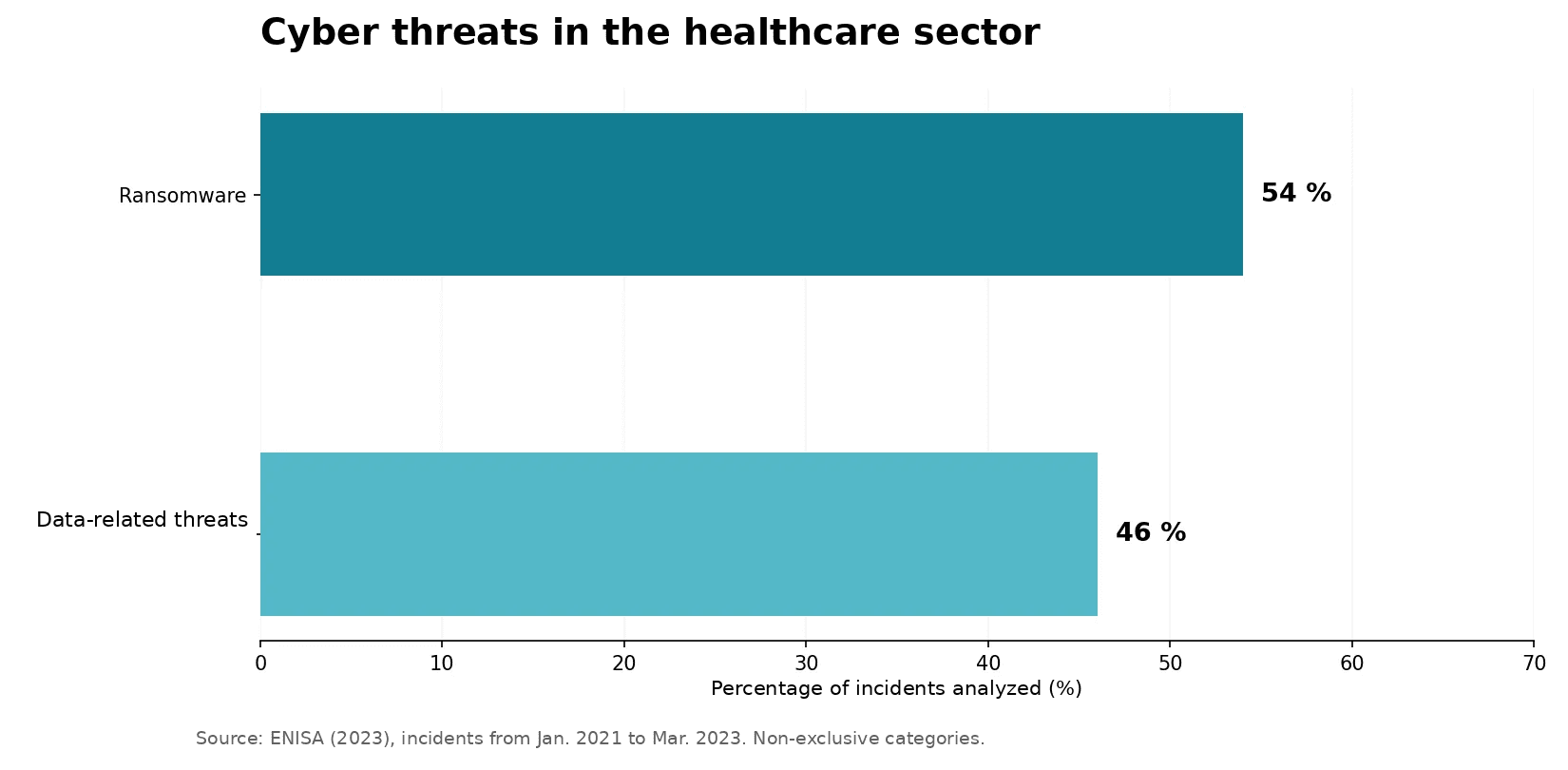
In an analysis published in 2023, the European Union Agency for Cybersecurity (ENISA) analyzed 215 incidents (Figure 1) in the healthcare sector and found that 54% involved ransomware attacks, while 46% focused on theft or leakage of medical information [1].
Real-world incidentes: when a cyberattack impacts a hospital
The consequences of a technology breach in the healthcare environment are not theoretical:
- Hospital Clínic de Barcelona: surgeries and consultations suspended
In March 2023, Hospital Clínic de Barcelona suffered a ransomware attack that forced the suspension of approximately 150 surgical procedures and thousands of outpatient visits, severely disrupting a range of clinical services [2]. The incident highlighted the importance of having prevention, rapid response, and care continuity measures in place.
2. Synnovis and the British NHS: providers are also part of the risk
In June 2024, Synnovis, a laboratory service provider for the UK's National Health Service (NHS), suffered a ransomware attack [3]. NHS England reported delays in more than 11,000 appointments and clinical procedures across the public health system. The case demonstrates that third-party technology providers represent a critical risk vector for hospitals.
Biometric security and privacy by design
Biometrics demands a qualitatively higher level of protection than other identifiers: while a compromised password can be reset instantly, a person's physical characteristics are irreplaceable.
For this reason, security and privacy are part of Heuristik's technology right from its inception. Our solution enables individuals to be identified through fingerprint recognition using artificial intelligence and specialized algorithms, ensuring reliable identification in healthcare environments.
To achieve this, we have designed an architecture that combines data protection, secure biometric processing, and deployment flexibility, allowing operation both on our infrastructure and in local environments (On-Premise).
The following diagram shows how our technology integrates into hospital processes and the security measures accompanying each stage (Figure 2):
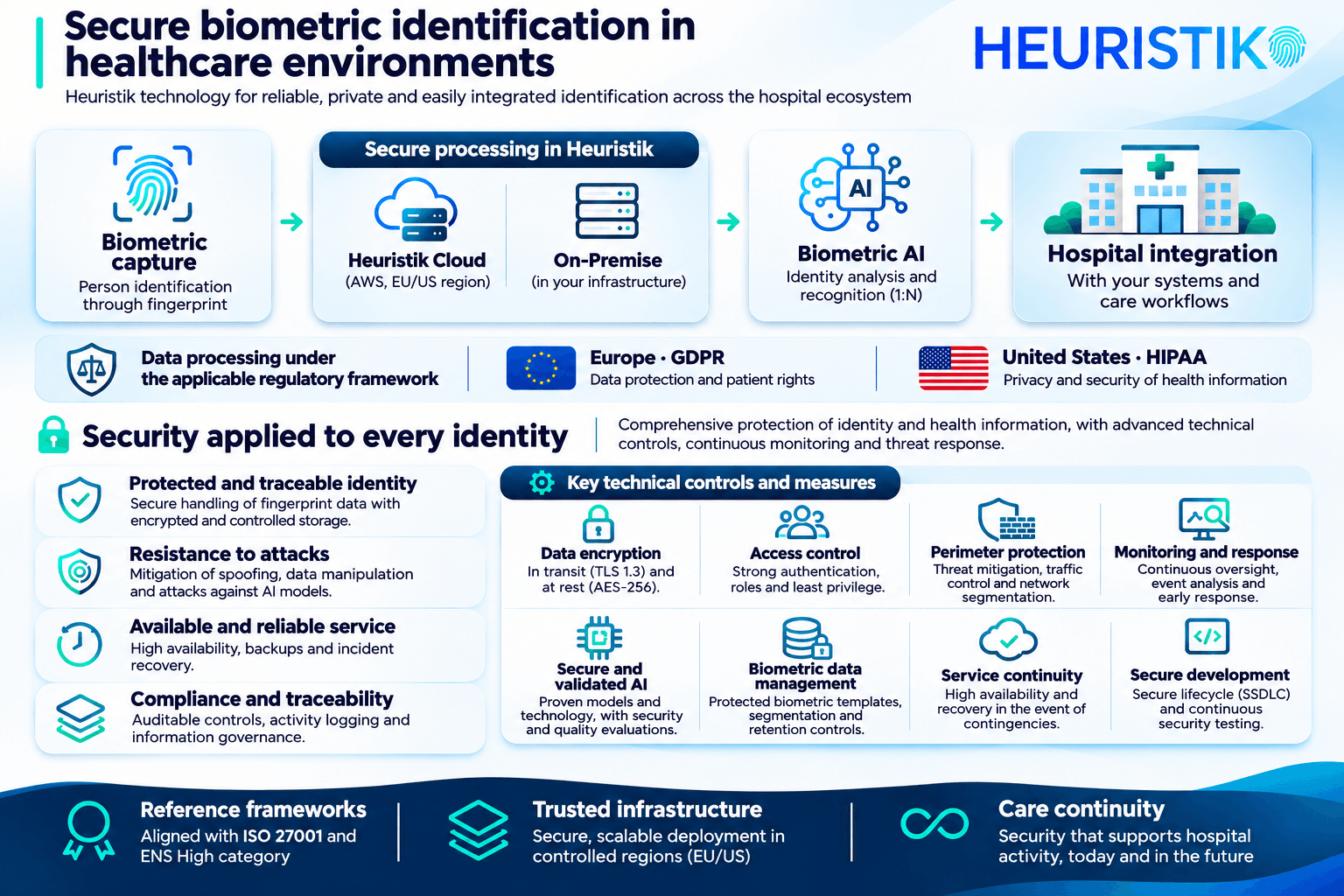
Security is applied throughout the identification process, from biometric capture to integration with hospital systems, through various mechanisms:
- Information protection: encryption of data in transit and at rest, ensuring secure communications during data processing.
- Isolation and access control: logical segregation between organizations and centers, reinforced authentication, and restricted permissions.
- Supervision and prevention: event monitoring, threat detection, and continuous vulnerability analysis.
- Reliable biometric AI: use of tested models and technologies, with quality controls and evaluation of algorithm accuracy.
Security and compliance: controls backed by our ISO 27001 and ENS HIGH category certifications, along with data protection measures adapted to applicable regulatory frameworks.
This approach enables us to offer hospitals and healthcare organizations a biometric identification solution that combines accuracy, security, and integration capabilities, keeping identity protection as a priority.
ISO 27001: security integrated into our technology
Heuristik holds the ISO/IEC 27001 certification for its Information Security Management System (ISMS) [4]. This recognition demonstrates that we have implemented a risk management model, controls, and continuous improvement evaluated through a certification process.
In our daily activity, this translates into encryption and protection of communications, access control, logical separation between organizations and centers, threat monitoring, vulnerability analysis, and secure development. We also maintain incident response and recovery procedures to reinforce service continuity.
For Heuristik, ISO 27001 is not just a documentation standard: it is part of the design, development, and operation of our biometric identification technology.
ENS HIGH category: reinforced measures for demanding systems
Heuristik has also obtained compliance certification with the National Security Framework (ENS) in the HIGH category for the systems included in the certified scope.
Regulated by Royal Decree 311/2022, the ENS establishes security requirements based on the potential impact of an incident. The HIGH category sets reinforced requirements and requires an audit to certify compliance.
In practice, this framework is reflected in measures to prevent unauthorized access, traceability, supervision, vulnerability management, incident response, and service continuity. These are especially relevant when our technology is integrated into clinical processes where availability and identity protection are essential.
Both certifications are complementary: ISO 27001 evaluates the security management system; ENS HIGH certifies the compliance of systems within its scope. Neither completely eliminates risks, but both provide evidence of implemented and audited security.
What does this mean for hospitals and healthcare organizations?
When choosing a biometric identification provider, it is not enough to evaluate product accuracy. Data protection, access management, traceability, service continuity, and the security of integrations with clinical infrastructure also matter.
Having a provider with ISO 27001 and ENS HIGH category certifications facilitates technical approval by hospital IT departments, providing evidence of a management and protection framework subject to external auditing. As with any certification, hospitals must consider their specific scopes and regulatory obligations.
Protecting identities is building trust
At Heuristik, we believe biometric innovation and security must advance together. Obtaining ISO 27001 and ENS HIGH category certifications consolidates ongoing implementation, auditing, and continuous improvement, reinforcing the trust of hospitals and organizations integrating our technology.
Because behind every identity, there is a person. Protecting that identity is a responsibility.
Discover Heuristik's biometric identification solutions for hospitals and learn about our Information Security Policy.
References:
[1] European Union Agency for Cybersecurity (ENISA). (2023). Checking up on health: Ransomware accounts for 54% of cybersecurity threats. https://www.enisa.europa.eu/news/checking-up-on-health-ransomware-accounts-for-54-of-cybersecurity-threats
[2] RTVE Noticias. (2023, March 6). El Hospital Clínic desprograma 150 cirugías y 3.000 visitas por un ciberataque de origen extranjero. [Hospital Clínic cancels 150 surgeries and 3,000 appointments due to a foreign-origin cyberattack] https://www.rtve.es/noticias/20230306/clinic-desprograma-150-cirugias-3000-visitas-ciberataque-origen-extranjero/2430020.shtml
[3] NHS England. (2024).Synnovis cyber incident: Clinical impact update. https://www.england.nhs.uk/synnovis-cyber-incident/
[4] International Organization for Standardization (ISO). ISO/IEC 27001: Information security management systems. https://www.iso.org/standard/27001